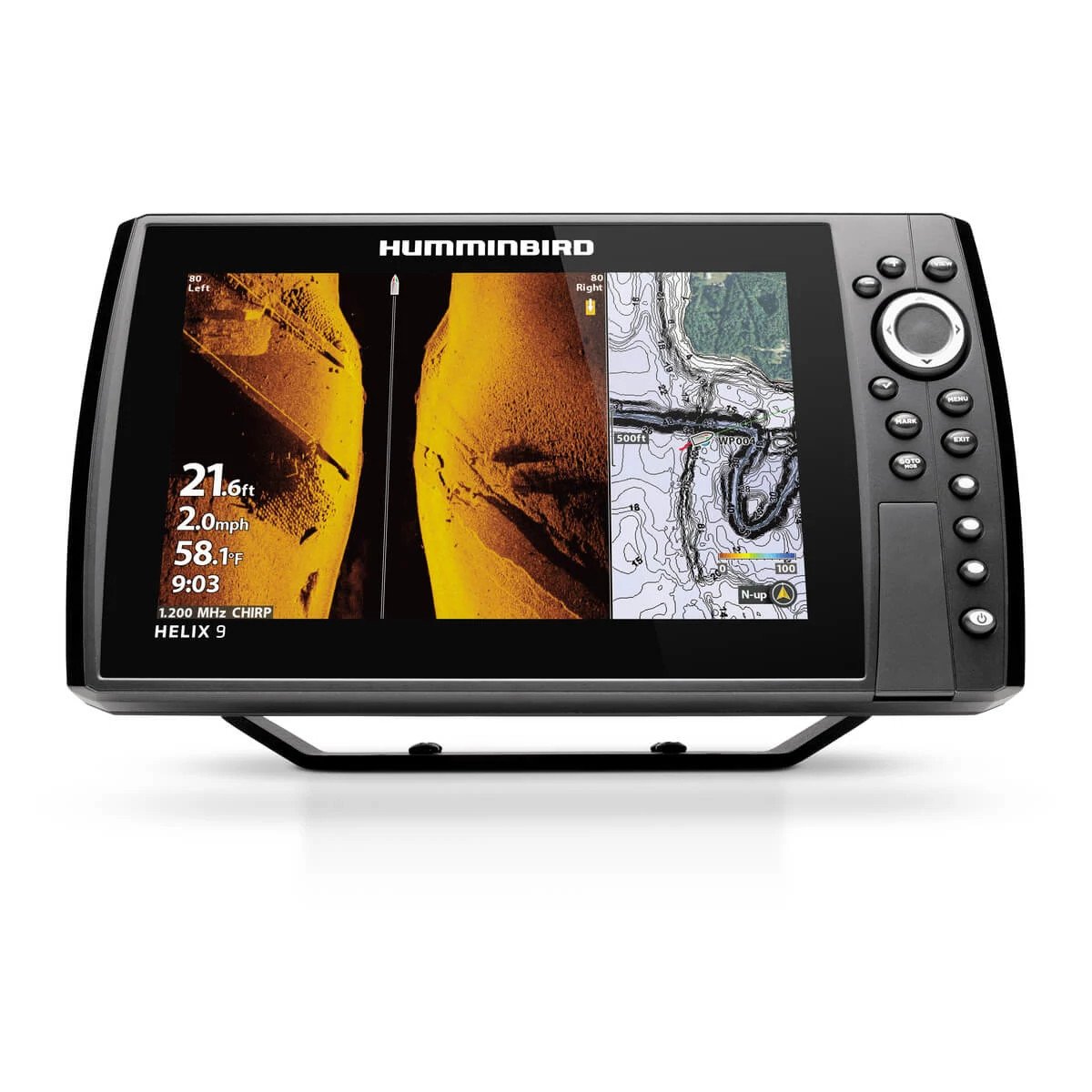
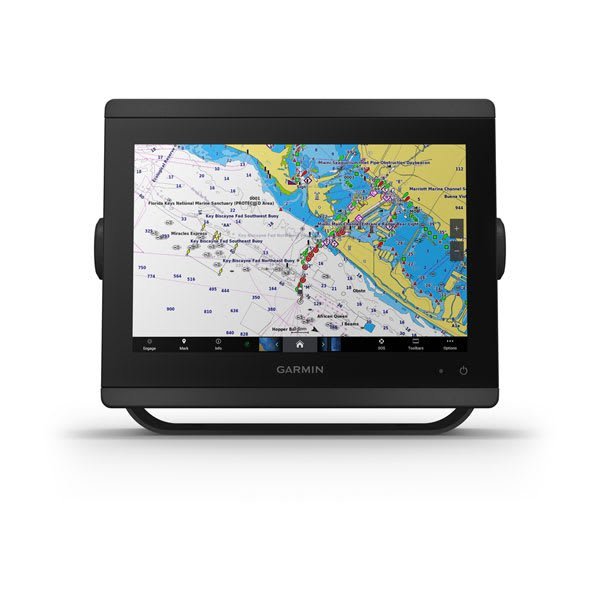
These three terms get thrown around constantly in fish finder marketing, and they genuinely do different things. Here’s what each shows you and when to use it.
CHIRP (traditional) sonar
CHIRP sends a sweep of frequencies rather than a single pulse, giving sharper target separation than older sonar. It shows a vertical slice of water directly beneath the boat — this is what gives you the classic “fish arch” and bottom hardness reading. It’s the best mode for tracking fish depth in real time while moving.
Down imaging
Down imaging uses a different frequency to produce a near-photographic picture of what’s directly under the boat — you can often make out individual fish, wood cover and rock piles far more clearly than on CHIRP. It’s slightly slower to interpret fish depth from, so most anglers run it alongside CHIRP rather than instead of it.
Side imaging
Side imaging scans out to either side of the boat rather than beneath it — brilliant for covering water quickly to locate structure, schools and drop-offs before you fish them. Think of it as a search tool, then switch to CHIRP or down imaging once you’ve found something worth stopping for.
Which do you actually need?
Most mid-range and above fish finders today include all three in one unit, so it’s less about choosing and more about learning to switch between them for the situation. Browse our full fish finder range or get in touch if you want help matching sonar features to how you fish.
Walking into fish finder shopping cold is genuinely confusing — screen sizes, sonar types and acronyms everywhere. Here’s what actually matters when choosing your first unit.
1. Screen size
Bigger isn’t always better — it’s about your boat and budget. A 5-7 inch screen suits kayaks and small boats. 9 inches is the sweet spot for most trailer boats. 12 inches and up make sense once you’re running split-screen views or forward-facing sonar regularly.
2. Sonar type
CHIRP (traditional) sonar — shows fish arches and bottom structure directly below the boat
Down imaging — near-photographic detail directly beneath you, great for identifying structure
Side imaging — scans wide to either side, excellent for covering water quickly to find structure and schools
3. Do you need GPS?
If you want to mark waypoints, navigate home in poor visibility, or eventually add charts, get a GPS-equipped unit from the start — retrofitting later means buying a new unit rather than adding a module.
In the £600-£1,000 mid-range bracket, Humminbird’s HELIX and Garmin’s ECHOMAP series are the two most popular combo fish finder/chartplotter ranges — both punch well above their price point. Here’s how they compare.
Choose ECHOMAP if you want Garmin’s Navionics chart ecosystem and a path to adding Panoptix LiveScope later.
Choose HELIX if you want MEGA Imaging sonar clarity and AutoChart Live’s self-building depth maps, particularly useful on less well-charted inland waters.
Prioritise screen size? The Humminbird HELIX 9 MEGA SI+ G4N with AutoChart Live gives the largest display in this bracket at £977.99.
Frequently Asked Questions
What’s the difference between “cv” and “sv” Garmin models? “cv” models include ClearVü scanning sonar only; “sv” models add SideVü for wider side-scanning coverage, at a higher price.
Is MEGA Imaging better than Garmin’s scanning sonar? Both are strong performers — Humminbird’s MEGA Imaging is often praised for sharper structure detail, while Garmin’s ClearVü/SideVü integrates tightly with the wider Garmin ecosystem including LiveScope.
Which is better value for a first combo unit? Both the Garmin ECHOMAP UHD2 73cv GN+ with GT20-TM Transducer and Humminbird HELIX 7 CHIRP MEGA DI GPS G4N Fish Finder sit at similar price points and are excellent first combo units — the choice mostly comes down to chart and ecosystem preference.
Still deciding between HELIX and ECHOMAP? Our team can talk through your priorities — browse both ranges in our online shop.
Choosing between the Humminbird XPLORE 9 CMSI+ and the Garmin ECHOMAP UHD2 93sv is one of the toughest calls in marine electronics right now. Both are elite 9-inch fish finders loaded with sonar tech, GPS, and networking — but they take different approaches to nearly every feature. We break it all down.
Quick Verdict
The XPLORE 9 CMSI+ wins on imaging clarity and included mapping value. The ECHOMAP UHD2 93sv wins on sonar versatility and Garmin ecosystem integration. If MEGA imaging and premium maps matter most, go Humminbird. If you want Garmin’s Panoptix LiveScope compatibility and deeper ActiveCaptain integration, go Garmin.
Display & Interface
Both units feature 9-inch displays, but Humminbird’s glass-bonded panel gives it an edge in direct sunlight readability. The XPLORE’s Cross Touch interface — simultaneous touchscreen and keypad — is outstanding for gloved hands on rough water. Garmin’s touchscreen on the ECHOMAP UHD2 is responsive and clean, with a straightforward menu system familiar to any Garmin user.
Humminbird’s higher resolution display is a clear advantage for reading fine detail in imaging returns.
Sonar Capability
This is where both units flex their best technology.
The XPLORE 9 leads with MEGA Side Imaging+ and MEGA Down Imaging+ — Humminbird’s highest-frequency imaging sonar, delivering photographic-quality underwater pictures out to 60 metres (200 feet) on each side. Combined with Dual Spectrum CHIRP for traditional sonar, it covers every water column scenario.
The ECHOMAP UHD2 93sv runs Ultra High-Definition scanning sonar (UHD) plus CHIRP sonar, and is fully Panoptix LiveScope compatible. If real-time forward-scanning live sonar is on your must-have list, only Garmin delivers it natively at this tier.
XPLORE 9 wins: MEGA imaging resolution, wider side range, sharper bottom detail
ECHOMAP UHD2 wins: LiveScope forward sonar compatibility, more transducer options
Built-In GPS & Maps
For UK and European buyers, mapping is closer than the US spec sheets suggest. The XPLORE 9’s premium map card equivalent for our waters comes via compatibility with C-MAP European coastal charts and detailed inland coverage, while Garmin’s ECHOMAP UHD2 93sv is pre-loaded or compatible with Garmin Navionics+ Western Europe grids and Navionics UK & Ireland charting — excellent for both coastal and freshwater work. Budget roughly £150 if you add a premium regional chart card to either unit.
ECHOMAP UHD2 93sv: Garmin Navionics+ Western Europe / Navionics UK & Ireland compatible
Networking & Ecosystem
Both units offer Wi-Fi, Bluetooth, NMEA 2000, and Ethernet. Humminbird’s One-Boat Network connects the XPLORE 9 natively to Minn Kota trolling motors and Cannon downriggers — ideal if your boat already runs Minn Kota Ulterra or Ultrex. Garmin’s ecosystem is equally strong, with Panoptix LiveScope, Force trolling motor integration, and the full Garmin marine suite via GN network.
Price Comparison
Feature
Humminbird XPLORE 9 CMSI+
Garmin ECHOMAP UHD2 93sv
Price
£1,299.99
~£1,199.99
Display
9″ 1280×720 glass-bonded
9″ 800×480 multi-touch
Imaging
MEGA SI+ / MEGA DI+
UHD Scanning Sonar
Live Sonar
MEGA Live 2 compatible
Panoptix LiveScope compatible
Maps Included
Basemap + premium regional charting
Navionics+ Western Europe compatible
Networking
Wi-Fi, BT, NMEA 2000, Ethernet
Wi-Fi, BT, NMEA 2000, Ethernet
Who Should Buy the Humminbird XPLORE 9 CMSI+?
Pike, perch, zander or coarse anglers who want the best imaging sonar available
Anglers running Minn Kota trolling motors (One-Boat Network is seamless)
Anyone who fishes inland lakes and wants premium mapping without extra cost
Buyers who value a higher-resolution, glass-bonded display for sunny days on the water
Who Should Buy the Garmin ECHOMAP UHD2 93sv?
Anglers who want Panoptix LiveScope real-time forward sonar (a game changer for sight fishing)
Coastal boaters who rely on Navionics UK & Ireland navigation
Existing Garmin users who want ecosystem consistency across devices
Budget-conscious buyers who want to allocate savings toward a LiveScope transducer
Bottom Line
Both are exceptional fish finders — you won’t make a wrong choice here. The Humminbird XPLORE 9 CMSI+ delivers more value out of the box with superior imaging and included premium maps. The Garmin ECHOMAP UHD2 93sv edges ahead for anglers committed to the Panoptix LiveScope ecosystem. Either way, both are available now at Pro Marine Electronics with free delivery on qualifying orders — and every unit includes a full manufacturer warranty completely valid for local servicing and technical support within the UK and Europe.